

Home Program/Courses
Upcoming Events
green_taraThu Feb 23
Kalachakra Six Session Guru Yoga Retreat
Thu Feb 23
Pre-Ordination Course
meditations on path Mon-Sat at 9:15am
Fri Feb 24
09:15
- 10:15AM
Daily Guided Meditation
puja group picFri Feb 24
13:00
- 02:00PM
Sutra Reading
video day small Every Mon & Fri at 2pm
Fri Feb 24
14:00
- 03:30PM
Movie Day
video day small Every Mon & Fri at 2pm
Mon Feb 27
14:00
- 03:30PM
Movie Day
IntroMay09Wed Feb 29
13:00
- 01:00PM
Introduction to Buddhism
green_taraThu Mar 01
Intensive Seminar for Practitioners of Highest Yoga Tantra
video day small Every Mon & Fri at 2pm
Fri Mar 02
14:00
- 03:30PM
Movie Day
puja group picSat Mar 03
18:30
- 09:00PM
Guru Puja
Medicine Buddha Retreat

The 2012 Medicine Buddha Retreat will take place during the second half of 2012
(sometime between September - November). Please check our website for exact dates in April 2012. See more information about the reasons for this here.

medicinebuddha

Background to the Medicine Buddha Practice

To the Bhagavan with great compassion,

Whose name when merely heard dispels sufferings of the lower realms.

Dispeller of disease and the three poisons,

I prostrate to the Medicine Buddha Lapis Lazuli Light.

Many aeons ago, seven bodhisattvas strongly prayed for the temporal and ultimate happiness of all sentient beings and that their names would become wish-fulfuling in order to heal both the mental and physical sicknesses and diseases of sentient beings.

They vowed that their prayers will be actualized during these degenerate times when the teachings of Shakyamuni Buddha are in decline. When they became enlightened, one of the ten powers of a Buddha is the power of prayer - that means that all the prayers that have been made get fulfilled. As the Buddha's holy speech is irrevocable, you can wholly trust in their power to quickly grant blessings to help all sentient beings in these degenerate times.

They are called the Seven Medicine Buddhas. The main one is 'Lapis Buddha of Medicine, King of Light'. Buddha Shakyamuni taught the teachings on the Medicine Buddha, and according to one tradition, is also considered as one of the Medicine Buddhas, and hence the Eight Medicine Buddhas.

About the Medicine Buddha Retreat

medicine1This is a practice belonging to the Kriya Tantra, the first of the four classes of tantra. During the retreat, we will do four sessions each day, starting with taking the Eight Mahayana Precepts in the morning, followed by Combined Jorcho/Lama Chopa in the first session, and three sessions of the Medicine Buddha Sadhana.

The sadhana (or method of accomplishment) called "The Source of Benefit and Happiness" consists of taking refuge, generating bodhicitta, and making requests to the Medicine Buddha lineage lamas to receive inspiration. This is followed by a front generation of Medicine Buddha's Mandala, which consists of eight Medicine Buddhas, Manjushri, Chenresig, Vajrapani, Maitreya and the rest of the entourage. In front of this elaborate, beautiful merit field, we recite the mantra of Medicine Buddha to receive blessings. Although accumulating mantra is not the main focus of the retreat, for those who are able, we will try to accumulate 10,000 mantras.

According to the advice of Lama Zopa Rinpoche, we will also do prostrations to the Thirty Five Buddhas before each session. To make the practice more experiential and meaningful, lam rim meditations will be incorporated, as a motivation for the practice and to leave strong imprints of both sutra and tantra in our mindstreams.

At the end of the retreat, we will offer extensive dedication for the long lives of our teachers and for world peace. There will also be a Dorje Khadro fire puja to purify our negativities and any mistakes made during the retreat.

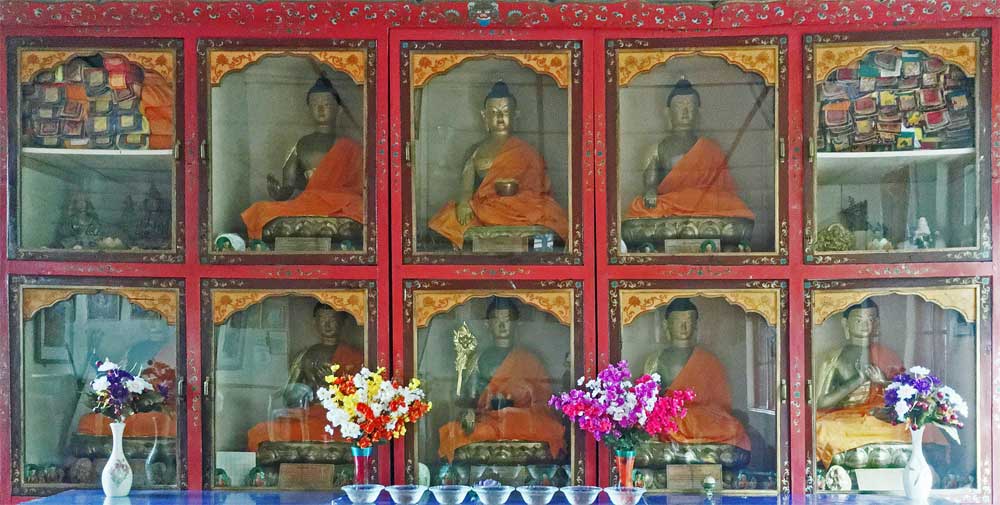
The Retreat will take place in the Medicine Buddha Gompa of Tushita, in the presence of our eight life-size Medicine Buddha Statues.

Benefits of the Practice

  • Our Spiritual Director, Lama Zopa Rinpoche, explains: "Any living being who hears the name of Medicine Buddha never gets reborn in the lower realms - that's the benefit of just hearing the name, the mantra of Medicine Buddha. This is due to the great compassion of the Medicine Buddhas."
  • It is very powerful for purification - it purifies any broken vows or precepts.
  • It is very powerful for healing sickness.
  • And not only that, it is also very powerful for success.

Normally people think that Medicine Buddha is for healing but it's not only that! You can use the Medicine Buddha practice for ANY purpose, ANY problem, ANYTHING. The Medicine Buddha practice is so precious.

Requirements to join the Retreat

The retreat requirements change every year according to the retreat structure.

The basic requirements for every Medicine Buddha retreat are:

  • You should be a Buddhist, having formally taken refuge in the Buddha, Dharma and Sangha. Those who have not formally taken refuge or who have not participated in a tantric retreat before, will need to have an interview with Tushita's Spiritual Programme Coordinator and/or the retreat leader.
  • You should have taken the Medicine Buddha Initiation, which will require taking the Bodhisattva Vows. Tushita will arrange for the Medicine Buddha Initiation to be given by a qualified tantric master before the retreat starts.
  • You must be familiar with the Lam Rim (the Graduated Path to Enlightenment as presented in the Gelugpa Tibetan Buddhist tradition) and have attended at least one introductory course in Tibetan Buddhism.

Registration

You can register by filing out our online form.

 
Rules of Discipline

It is only possible to stay at Tushita if you are taking one of our residential courses/retreats or are an established Buddhist practitioner doing your own formal Buddhist retreat of a minimum of 10 days duration.silence_small

Since Tushita is a semi-monastic meditation centre and not a guesthouse, we ask all of our retreatants and visitors to observe the following rules of discipline in order to maintain an atmosphere conducive to inner reflection and meditation:

  • Respect all life: do not intentionally kill any living being, even small insects.
  • Respect others' property: do not steal or take anything not freely given.
  • Be honest and straightforward: do not lie or intentionally deceive others. This is easy when observing silence!
  • Be celibate: no sexual activity. This also includes no holding hands, hugging, massages and other physical displays of affection.
  • Be alert and mindful: avoid intoxicants such as alcohol, drugs and cigarettes (we encourage you to stop smoking while here, but if this is impossible, one can smoke at a designated place within the centre boundary).
  • Be considerate of others' silence: keep silence in the appropriate areas and at all times during residential courses, especially in the Gompa and the dormitories. No singing or playing music and in general, maintain a quiet demeanor while on the property.
  • Be considerate of the monks and nuns: dress respectfully (please no shorts above the knee, tank-top shirts or tight and revealing clothing).
 
Basic Course Discipline

In order to keep the atmosphere conducive to inner reflection and spiritual pursuit and to minimise distractions during the course, students on our residential courses and retreats are asked to abide by our basic code of discipline listed below.

  • Please settle all outside communication before the course begins. Telling friends and family that you will be out of contact for the duration of the course and sticking by that decision significantly reduces distraction from investigation into the workings of your own mind! Likewise, please settle your travel arrangements etc before you come to Tushita!
  • You are expected to observe silence (no talking at all) from the evening of the first day until the end of the course.
  • Do not leave Tushita property for the entire course.
  • Participants must attend all sessions of the course and come to sessions on time.
  • Please put all communication / entertainment devices (laptop / mobile phones /cameras / MP3/CD players) etc into our safe at check-in.
  • Please be gentle in your behaviour and sensitive to fellow group members.
 
Gompa Etiquette

"Gompa" is a Tibetan word which we use for Meditation Hall. Because a Gompa is the location of study, meditation and devotional practices, Buddhists consider them to be holy places. In this tradition, the following modes of behaviour are considered respectful in a Gompa and we ask you to follow them while here:

  • Do not point your feet towards the teachers, the altar or any holy object.
  • Do not put Dharma materials – prayer books, texts, Dharma books or notebooks with Dharma in them – on the floor, or sit or step over them.
  • Do not lie down or do any yoga exercises in the Gompa at any time.
  • No idle chit-chat in the Gompa (ie. You can ask the teacher questions during class, but do not talk with other students).


Thank you so much for your support.


Powered by Multicategories Component for Joomla!1.5